Studies on Jacob Böhme

Nikolai Berdyaev

Translated by Andrei Srulikov


Jacob Böhme is a notoriously forbidding author. He expresses himself in the registers of myth and personal revelation. He forges his metaphors and analogies with the vocabulary of alchemy, which has become incomprehensible to us. He draws his references from the wellspring of Scripture, which we no longer know. He plunges into the heart of the Bottomless Abyss to contemplate the generation of God from within the Godhead, in wrath and anger.

Yet this obscurity and strangeness should not discourage us from discovering an author decisive in the development of Western philosophy. For it was from the fundamental intuition of Jacob Böhme—that of the Ungrund—that German Idealism drew its sustenance. Without the theosophical cobbler of Görlitz, Fichte, Hegel, and Schelling could never have freed themselves from the mental prisons built by the Hellenes.

But did this appropriation, under the guise of conceptual and scientific transcendence, not miss the singularity of Jacob Böhme? Nikolai Berdyaev, because he mastered philosophy from an extra-philosophical standpoint—that of an ardent and indomitable faith—was able to grasp and convey this singularity. In these studies, first published in the émigré journal Put' (1929–1930) and here translated for the first time from the Russian original, Berdyaev introduces us to the heart of this Vision in clear terms, but from the Seer's standpoint and in spiritual empathy with him.

About This Edition: This volume presents, for the first time in English, the complete translation of all three texts Berdyaev devoted to Jacob Böhme. The study on Sophia and the Androgyne has never before appeared in English. The translator has restored the German citations from Böhme's works in scholarly footnotes.
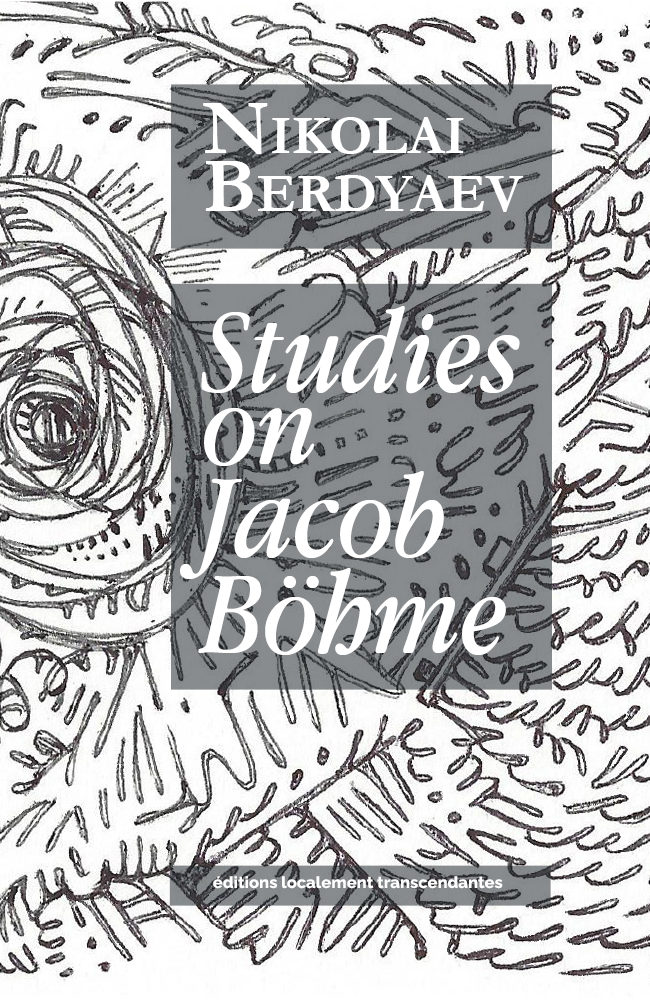
Studies on Jacob Böhme

Publication: 12/31/2025

109 pages

12.7x20.32 cm (5x8 in)

ISBN 978-2-38366-063-7

$17.00

All our books are easily available online. However, by ordering through your local bookstore, you save on shipping costs and support places of living and independent intellectuality.

Extracts

From the Foreword

What enables Berdyaev to achieve this sympathetic understanding is his own position as a religious philosopher—one who thinks philosophically about ultimate questions while remaining rooted in spiritual experience and Orthodox Christian faith. He recognizes in Böhme a kindred spirit: a Christian visionary grappling with the deepest mysteries of existence, theodicy, and divine freedom. Where academic philosophers see confused proto-idealism, Berdyaev sees profound theological wrestling. Where they see problems to be solved through conceptual clarification, he sees mysteries to be contemplated through spiritual empathy.

Beyond serving as an unparalleled introduction to Böhme's vision and its fateful appropriation by German Idealism, these studies offer perhaps the clearest exposition of Berdyaev's own metaphysical position—his doctrine of uncreated, meonic freedom rooted in the Ungrund, which constitutes the generative core of his entire philosophical edifice.

On Böhme's Sources of Knowledge

Böhme's gnosis was experiential and vital; it arose from anguish over the fate of man and the world. Böhme possessed a childlike purity of soul, a kind and compassionate nature. Yet his feeling for the life of the world was austere, not sentimental. His fundamental intuition of being was an intuition of fire. In this he is akin to Heraclitus. He possessed an extraordinarily acute and powerful sense of evil in the life of the world. Everywhere he perceives a struggle of opposing principles, a struggle of light and darkness.

Unlike the majority of mystics, Böhme writes not of his own soul, nor of his own spiritual path, nor of what happened to him, but of what happened to God, to the world, and to man. This is the distinguishing mark of mystical theosophy as opposed to pure mysticism.

On Freedom and the Ungrund

Böhme's teaching on freedom is not a psychological and ethical doctrine of freedom of the will; it is a metaphysical teaching on the first-foundation of being. Freedom for him is not the grounding of man's moral responsibility, nor the regulation of man's relations to God and neighbor, but the explanation of the genesis of being and, together with it, of the genesis of evil as an ontological and cosmological problem.

The primal mystery of being, according to Böhme, consists in the fact that nothing seeks something. Böhme describes apophatically and antinomically the mystery that unfolds in the depths of being, in that depth which borders upon primordial nothingness. In the darkness a fire is kindled and light begins to dawn; nothing becomes something; groundless freedom gives birth to nature.

On Sophia and the Androgyne

The teaching on Sophia is inseparable in Böhme from the teaching on the androgyne, that is, on the primordial integrity of man. Sophianicity is, in essence, androgyny. Man possesses an androgynous, bisexual, male-female nature. To man belongs Sophia, that is, the Virgin. The fall is precisely the loss of one's Sophia-Virgin, who departed to heaven. On earth there arose femininity—Eve. Man yearns for his Sophia, for the Virgin, for integrity and chastity. A sexual being is a sundered being, one that has lost its wholeness.

When the unschooled Böhme first heard the word "idea," he exclaimed: "I see the Heavenly Virgin!" This was a vision of Sophia, of Sophianic man, of the male-virgin. The world was created by God through Sophia-Wisdom, by means of God's creative imagination.

On Böhme's Significance

The German metaphysicians of the nineteenth century attempted to express the musical theme in a system of concepts. In this lies the grandeur of their design, and in this lies the cause of the collapse of these systems. A revival of Böhme is now possible. A number of new books are being written about him. He can help overcome not only the habits of Greek thought and medieval scholasticism, but also that German idealism upon which he himself exerted an internal influence.

For us Russians, Böhme, like Franz Baader, ought to be closer than other Western thinkers. By the properties of our spirit we are called to construct a philosophy of tragedy; the optimistic rationalism of European thought is alien to us. Böhme so loved freedom that he perceived the true church only where freedom exists.

About the Author

Nikolai Alexandrovich Berdyaev (1874–1948) was a Russian religious and political philosopher who became one of the most significant voices of twentieth-century Christian existentialism. Born in Kiev into an aristocratic family, he moved from Marxism to idealism and finally to a distinctive form of Christian personalism centered on the primacy of freedom and creativity.

Expelled from Soviet Russia in 1922 on the famous "Philosophers' Steamship," Berdyaev settled in Paris where he founded and edited the influential journal Put' (The Way) and led the Religious-Philosophical Academy. His major works include The Meaning of the Creative Act (1916), The Destiny of Man (1931), Freedom and the Spirit (1927), and Slavery and Freedom (1939).

Berdyaev's philosophy is characterized by its rejection of all forms of objectification that reduce persons to things, its affirmation of uncreated freedom as prior to being, and its vision of human creativity as participation in God's ongoing creation. His engagement with Jacob Böhme was decisive for his mature metaphysical position.