The Person of Jesus Christ

Hugh Ross Mackintosh


Kenotic theology, once considered a historical curiosity, is experiencing a remarkable resurgence that extends far beyond traditional theological circles. Contemporary thinkers such as David Bentley Hart and John Milbank have deeply engaged with kenotic ideas, applying them to a wide range of philosophical and theological questions. Hart, in particular, has explored how a kenotic understanding of God's relationship to the world might inform our approach to the problem of evil and the nature of divine freedom. Milbank, from his Radical Orthodoxy perspective, has considered how kenosis might reshape our understanding of divine power and the relationship between theology and secular thought.

Perhaps most surprisingly, the concept of kenosis has found traction in unexpected intellectual quarters, largely due to the work of Slovenian philosopher Slavoj Žižek. Despite his atheistic stance, Žižek has repeatedly engaged with Christian theology, particularly the notion of kenosis, seeing in it a powerful model for understanding subjectivity and revolutionary politics. His provocative readings of kenosis as a form of radical emptying that creates space for true freedom and ethical action have sparked discussions far beyond the boundaries of traditional theology.

It is in this context of renewed interest in kenotic thought that Hugh Ross Mackintosh's The Person of Jesus Christ, first published in 1912, finds unexpected relevance. This seminal work in the development of British kenotic Christology offers fresh perspectives on the perennial questions of Christ's divinity and humanity. Mackintosh's nuanced approach to kenotic theory, which emphasizes the self-consciousness of Jesus as the starting point for Christological reflection, provides a sophisticated solution to the Christological dilemmas that have challenged theologians for centuries. His careful balance between historical-critical study of the Gospels and attention to the experience of believers anticipates many modern theological discussions, making The Person of Jesus Christ a bridge between classical Christian thought and contemporary critical approaches.

Mackintosh's emphasis on the moral authority of Jesus as evidence of His divinity resonates with current theological concerns about the ethical implications of Christology. His insistence on connecting Christ's person to His saving work provides a model for integrating doctrinal reflection with pastoral application.

This edition features a comprehensive introduction that situates Mackintosh's work within its historical context and traces its influence on subsequent theological developments in Scotland and beyond. The Person of Jesus Christ remains a challenging and rewarding text, offering profound insights into the nature of God, the meaning of the Incarnation, and the relationship between divinity and humanity. It invites readers to engage deeply with one of Christianity's central mysteries, providing resources for ongoing theological reflection in our contemporary world. Mackintosh's distinctively Scottish approach to theology, combining intellectual rigor with pastoral concern and evangelical warmth, continues to offer a compelling vision of how Christology can inform and enrich Christian life and practice in the 21st century.
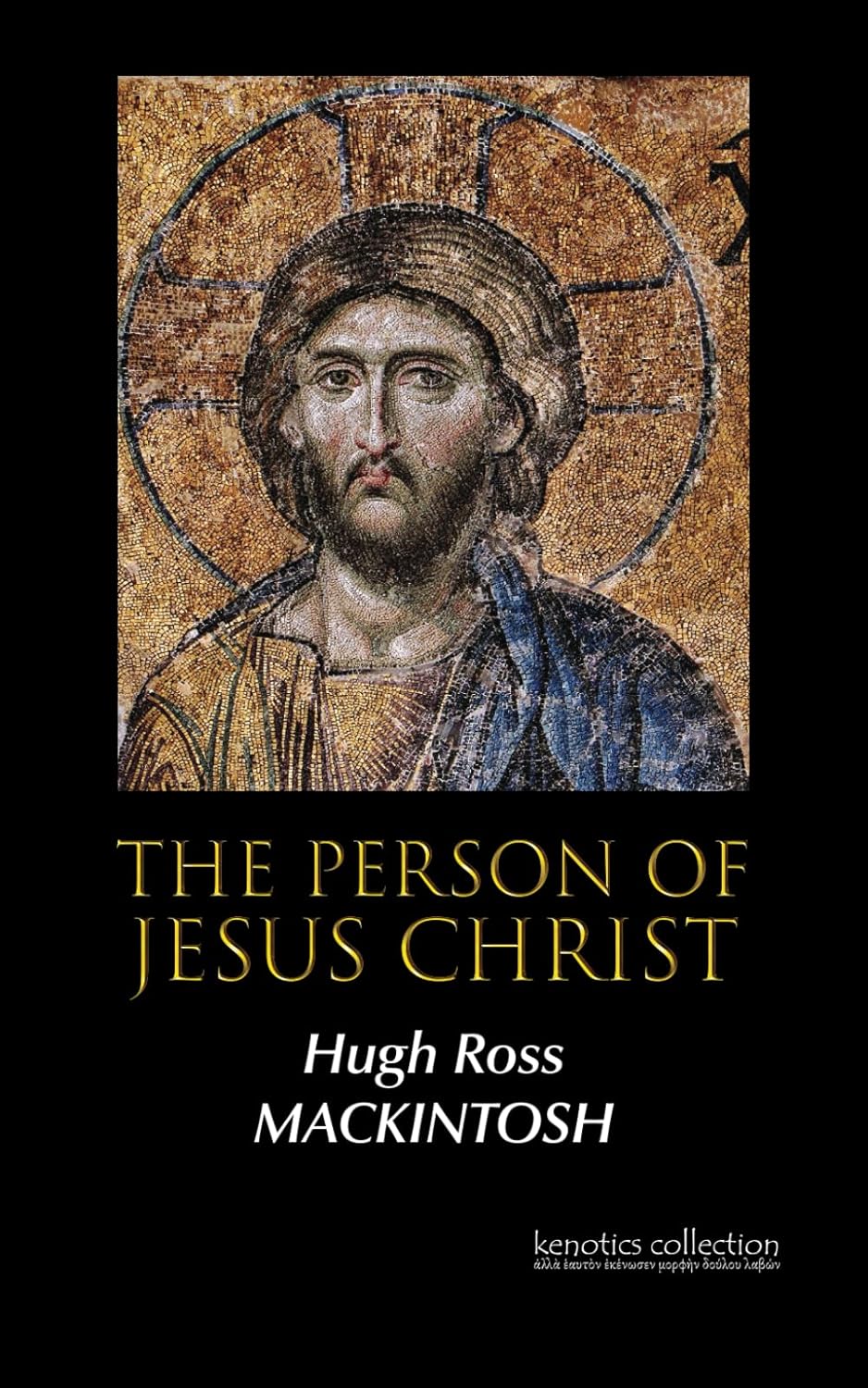
The Person of Jesus Christ

July 10, 2024

78 pages

12.7x20.32 cm (5x8 in)

ISBN 978-2-38366-043-9

$10.00

All our books are easily available online. However, by ordering through your local bookstore, you save on shipping costs and support places of living and independent intellectuality.

Extracts

On the Self-Consciousness of Jesus

The self-consciousness of Jesus — His thought of Himself, that is, and of His redeeming mission to the world — is not merely the greatest fact which concerns Him; it is the greatest fact in all history. It is from this point, therefore, that we ought to start.

It is right to emphasize at the outset the immense significance of the fact that Jesus Christ should have had an absorbing consciousness of Himself, or rather of God and Himself as bound up together. No man in his senses would dream of employing the phrase "God and I," yet just this is Jesus' tone. He cannot think of Himself without thinking also of God Who sent Him and Who is perpetually with Him. Still more amazing, He cannot think of God but that His mind instantly settles on Himself as God's indispensable organ and representative.

Take Buddha. When Buddha dies, he gives instructions that his disciples may forget him if only they remember his teaching and the way that he has shown them. Or, again, take Socrates. What he is concerned about at the end is the truth he has given his life to elucidate. These two are nearer to Jesus in moral power and originality than is any other; yet it is clear that it had not occurred to them to take a central position in the affections and thoughts of mankind. How different is it with Jesus! He came to lead men to God; and yet He knows no more sacred task than to point them to His own Person.

On the Originality of Redemption

Men and women like ourselves have been re-created by His influence, changed in the depths and inmost secrets of being. In every man that change takes a different, because a personal, shape. His redemption is as original and individual a fact as the colour of his eyes. Each rising sun, touching the wing of sleeping birds, wakes over the woods a fresh burst of melody, as if the sun had never risen before; and just so, wherever a man finds and grasps redemption, faith in the heart is a new creation, as if he were the first to discover Jesus.

Christ remains past only as long as He is not faced in the light of conscience. So long as we bring into play our intellect merely, or the reconstructive fancy of the historian, He is still far off. The change comes when we take up the moral issue. If we turn to Him as men keen to gain the righteous, overcoming life, but conscious so far of failure, instantly He steps forward out of the page of history, a tremendous and exacting reality. We cannot read His greatest words, whether of command or promise, without feeling that He not only said these things to men in Palestine, but is saying them to ourselves now.

His eyes seem to follow us, like those of a great portrait. When men accept or reject Him, they do so to His face.

The Saviour and the Leader

It is in the light of a sinner's conscience, and only there, that the fact of Christ becomes quite luminous. Within us all are two great elemental impulses, two vital and supreme desires. We crave an infinite gift which will satisfy even these insatiable hearts; a gift absolute, unending, eternal. We crave an infinite object also in which we may lose ourselves for ever and for ever. At once to take and to give in boundless measure; nothing less will satisfy the heart.

These two desires are met in the Christ whom we have studied. He is the Saviour, and He is the Leader. His gifts to us are wonderful — sin pardoned, sorrow lightened, death abolished, heaven opened, and a present God in every trouble. Through Him we are made personalities: no longer things, or links in a chain, but free men. But also He is the Leader, imposing on us an infinite demand. He leads us out into ever wider pastures of truth and duty, of service and self-denial from which there is no discharge, in a bond of union with Himself to which even death will make no difference.

About the Author

Hugh Ross Mackintosh (1870–1936) was one of the most significant Scottish theologians of the early twentieth century. Born in Paisley, where his father served as a Free Church minister, he studied at the University of Edinburgh and New College before pursuing further studies in Germany at Freiburg, Halle, and Marburg, where he formed a lasting friendship with the theologian Wilhelm Herrmann.

After serving as a minister in Tayport and Aberdeen, Mackintosh was appointed Professor of Systematic Theology at New College, Edinburgh, in 1904, a position he held until his death. This unique blend of pastoral ministry and academic theology gave him a perspective that was both rooted in ecclesial life and intellectually rigorous. In 1932, he was elected Moderator of the General Assembly of the Church of Scotland.

Mackintosh's theological legacy is considerable. His students included John Baillie and Thomas F. Torrance, two of the most influential theologians of the twentieth century. His major works include The Doctrine of the Person of Jesus Christ (1912), a comprehensive scholarly treatment of Christology, and The Christian Experience of Forgiveness, which creatively restates the doctrines of justification and atonement. He also translated important German theological works into English, including Schleiermacher's The Christian Faith and Ritschl's The Christian Doctrine of Justification and Reconciliation, thereby serving as a vital bridge between German and British theology.

Mackintosh exemplified a distinctively Scottish approach to theology, combining intellectual rigor with pastoral concern and evangelical warmth. As one contemporary noted, "Many a would-be theological student was converted in his classes." His work on The Person of Jesus Christ, drawn from lectures delivered at a Student Christian Movement conference, reveals the devotional depth and personal conviction that animated all his theological endeavours.