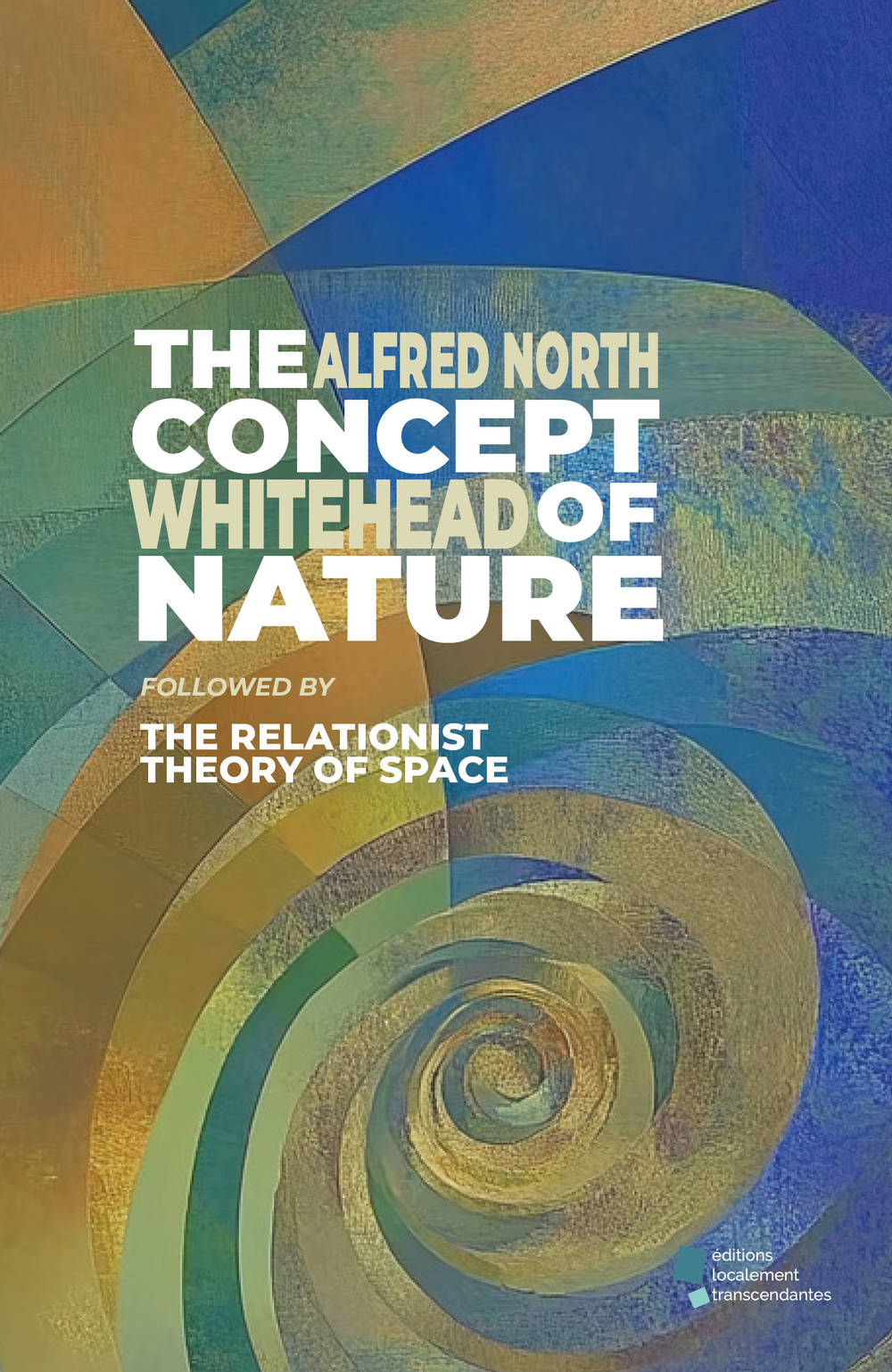
The Concept of Nature
followed by:
The Relationist Theory of Space

Alfred North Whitehead


A Groundbreaking Philosophy of Nature by One of the 20th Century's Most Original Thinkers

This special edition brings together two important works by Alfred North Whitehead, offering readers unprecedented access to the development of his revolutionary ideas about nature, space, and time.

In The Concept of Nature, Whitehead delivers a powerful critique of modern science's mechanistic worldview. Written at a time when Einstein's relativity was transforming physics, Whitehead presents an alternative vision where nature is not divided between what we perceive and what science describes—what he famously calls the "bifurcation of nature." Instead, he offers a unified understanding where nature is a complex process of interrelated events.

This edition includes, for the first time in English, Whitehead's article "The Relationist Theory of Space," translated from the original French. This technical companion piece elaborates on the logical foundations of Whitehead's spatial theory, providing the mathematical framework behind his innovative thinking.

The Concept of Nature

Publication: 04/21/2025

312 pages

12.7x20.32 cm

ISBN 978-2-38366-058-3

10.90 €

All our books are easily found online. However, by ordering them from your local bookstore, you save on shipping costs and support places of living and independent intellectuality.

Extracts

Foreword

Alfred North Whitehead's The Concept of Nature, first published in 1920, stands as a foundational text in the philosopher's intellectual development and in the broader landscape of 20th century philosophy of science. This seminal work, based on the Tarner Lectures delivered at Trinity College, Cambridge, marks a crucial transitional phase in Whitehead's journey from mathematician and scientist to metaphysician.

The early 20th century was a period of profound scientific upheaval, particularly with the emergence of Einstein's theory of relativity and the nascent field of quantum mechanics. These developments fundamentally challenged traditional understandings of space, time, and the material world. It was against this backdrop of scientific revolution that Whitehead formulated his innovative philosophy of nature, seeking to reconcile scientific discoveries with the immediacy of perceptual experience.

The Concept of Nature introduces several pivotal ideas that would later become instrumental to Whitehead's mature metaphysical system. Central to the book is Whitehead's critique of what he termed the "bifurcation of nature"—the problematic division between nature as it is perceived by consciousness and nature as it exists independently of perception. This critique lays essential groundwork for his later process philosophy, which would seek to overcome such dualisms through a more unified conceptual framework.

Preface (excerpt)

The contents of this book were originally delivered at Trinity College in the autumn of 1919 as the inaugural course of Tarner lectures. The Tarner lectureship is an occasional office founded by the liberality of Mr Edward Tarner. The duty of each of the successive holders of the post will be to deliver a course on "the Philosophy of the Sciences and the Relations or Want of Relations between the different Departments of Knowledge." The present book embodies the endeavour of the first lecturer of the series to fulfil his task.

The chapters retain their original lecture form and remain as delivered with the exception of minor changes designed to remove obscurities of expression. The lecture form has the advantage of suggesting an audience with a definite mental background which it is the purpose of the lecture to modify in a specific way. In the presentation of a novel outlook with wide ramifications a single line of communications from premises to conclusions is not sufficient for intelligibility.

This volume on "the Concept of Nature" forms a companion book to my previous work An Enquiry concerning the Principles of Natural Knowledge. Either book can be read independently, but they supplement each other. In part the present book supplies points of view which were omitted from its predecessor; in part it traverses the same ground with an alternative exposition.

About the Author

Alfred North Whitehead (1861-1947) was a British mathematician, logician, and philosopher who made fundamental contributions to mathematical logic, the philosophy of science, and metaphysics. Born in Ramsgate, Kent, he studied mathematics at Trinity College, Cambridge, where he later became a fellow and lecturer.

In collaboration with his former student Bertrand Russell, Whitehead co-authored the monumental Principia Mathematica (1910-1913), one of the most important works in mathematical logic and the foundations of mathematics. His early career focused on mathematics and logic, producing significant works including A Treatise on Universal Algebra (1898) and The Axioms of Projective Geometry (1906).

During his tenure at the University of London (1910-1924), Whitehead turned his attention to the philosophy of science, producing a trilogy of works on natural philosophy: An Enquiry concerning the Principles of Natural Knowledge (1919), The Concept of Nature (1920), and The Principle of Relativity (1922). These works developed an alternative interpretation of relativity theory and challenged prevailing scientific materialism.

In 1924, at age 63, Whitehead accepted a position at Harvard University, where he developed his comprehensive metaphysical system known as process philosophy. His magnum opus, Process and Reality (1929), presented a radical reconceptualization of reality as fundamentally constituted by processes and events rather than static substances. Other major philosophical works from this period include Science and the Modern World (1925), Religion in the Making (1926), and Adventures of Ideas (1933).

Whitehead's process philosophy has had lasting influence across diverse fields including theology, ecology, education, and contemporary physics. His philosophical system offers an alternative to the mechanistic materialism that dominated modern science, emphasizing the dynamic, relational, and experiential character of reality. He remained intellectually active until his death in Cambridge, Massachusetts, in 1947.