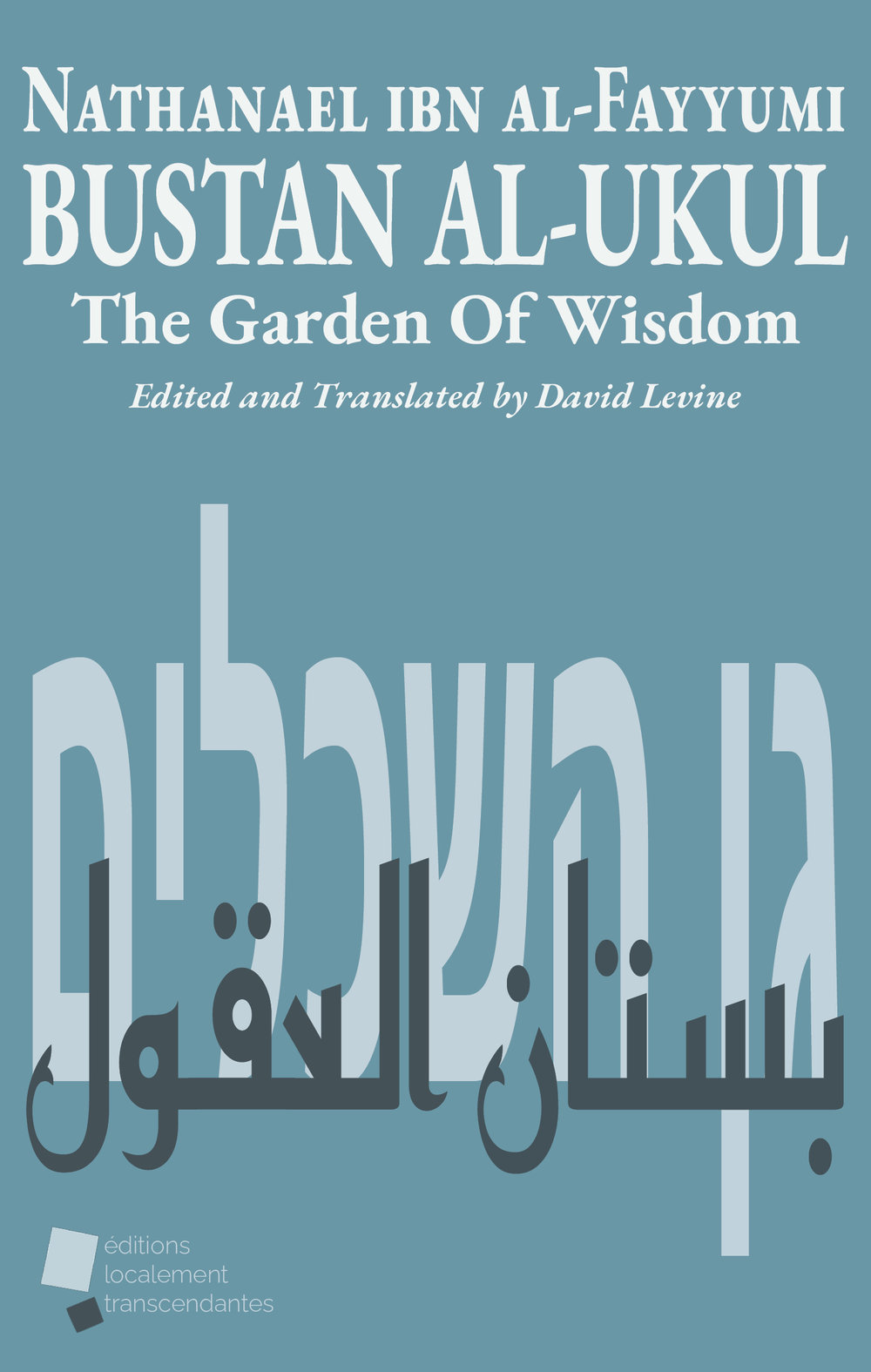
Bustān al-ʿUqūl
The Garden of Wisdom
Nathanael ibn al-Fayyūmī
Translated by David Levine · Foreword by Yeḥiel Davenne
Did a medieval rabbi recognize Muhammad as a true prophet?
In the twelfth century, in Yemen, a Jewish scholar wrote what may be the most theologically audacious sentence in the history of Jewish-Muslim relations: God sends a prophet to every nation according to its own language — and Muhammad was sent to the Arabs.
Nathanael ibn al-Fayyūmī was not a marginal figure. He was the head of Yemenite Jewry, writing for his own community, in Judeo-Arabic, with no Muslim reader in mind and nothing to prove to anyone outside it. What he wrote, he believed. And what he believed was that the Qur'an's own claim — "We sent a prophet only according to the language of his people" — could be cited as a legitimate proof-text within Jewish law itself.
He did not stop there. Drawing on the Talmud's seven prophets of the nations and the Noahide covenant given to all humanity, Nathanael constructed a complete theology of universal revelation: every people receives the prophet and the law suited to its capacity, while Israel alone carries the full weight — and the full responsibility — of the 613 commandments. Muhammad's mission, on this account, is neither fraud nor accident. It is one stage in a single divine pedagogy that will end, according to the prophet Joel, when God "pours out His spirit upon all flesh."
No other major Jewish thinker reached this conclusion. Saadia Gaon ruled Muhammad a false prophet by formal criteria. Judah Halevi made prophecy a biological privilege of Israel alone. Maimonides — the greatest systematizer in Jewish history — flatly contradicted himself on the question, granting Islam a providential role in spreading monotheism while denouncing its prophet as an impostor.
The position did not age into irrelevance. In 2002, the Chief Rabbi of the United Kingdom, Jonathan Sacks, wrote a far more cautious version of Nathanael's claim — that God "has spoken to mankind in many languages: through Judaism to Jews, Christianity to Christians, Islam to Muslims." The Orthodox rabbinical establishment forced him to retract it within a year. What a twentieth-century Chief Rabbi could not defend without controversy, a Yemenite rabbi had already argued — more rigorously, and from deeper within the tradition — eight centuries earlier.
Bustān al-ʿUqūl (The Garden of Wisdom) is not only about Islam. It is a complete work of medieval Jewish thought, covering the creation of the world, the nature of the soul, the eternity of the Torah, the reasons for the commandments, the coming of the Messiah, and the final redemption of all nations. Studied for generations among the Jews of Yemen, it reached the West through a single manuscript, translated into English by David Levine in 1908.
This edition reproduces Levine's translation in full, with a new foreword that situates Nathanael's position against Saadia Gaon, Judah Halevi, and Maimonides — and asks why a claim argued with such precision in the twelfth century can still provoke controversy in the twenty-first.